Class Types
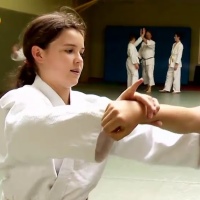
Newcomers
Fundamentals of movement, balance, falls, basic techniques and principles.
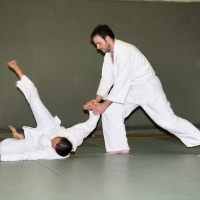
Beginners
Development of fundamentals with more demanding technique and timing.
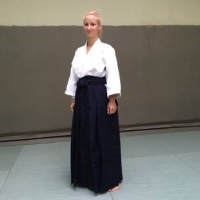
Advanced
Most demanding classes (from 3rd kyu), including multiple-attacker and weapons-related practice.
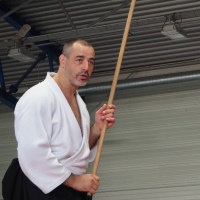
Jo
Staff training (128 cm). Recommended together with regular Aikido classes.
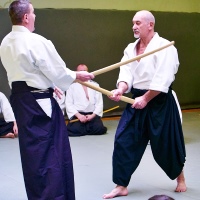
Bokken
Japanese wooden sword training, principles of ken-jutsu.
Fees
Employed
890 CZK
2,200 CZK
(740 CZK/month)
3,840 CZK
(640 CZK/month)
6,600 CZK
(550 CZK/month)
Students
790 CZK
1,920 CZK
(640 CZK/month)
3,240 CZK
(540 CZK/month)
4,920 CZK
(410 CZK/month)
Under 18
390 CZK
1,000 CZK
Exam Syllabus
KYU technical assessment is carried out by dojo leaders or qualified senior members. 1st KYU should be assessed by a committee led by at least 2nd DAN. Minimum time gaps and seminar counts between KYU grades are not required.
DAN grades include all possible combinations of attacks and techniques required in KYU exams. In addition, candidates are required to demonstrate Tanto dori, Jo dori, Tachi dori, and Jo nage waza, paired Jo practice (Kumijo), paired bokken practice (Kumitachi), as well as Randori and work against multiple attackers.
Tachi waza
- Ikkyo
- Nikyo
- Sankyo
- Irimi nage
- Shiho nage
- Kaiten nage
- Koshi nage
- Ikkyo
- Kote gaeshi
- Shiho nage
- Kokyu nage
- Nikyo
- Sankyo
- Kote gaeshi
- Kaiten nage
- Koshi nage
- Ushiro kiri otoshi
- Sankyo
- Kote gaeshi
- Shiho nage
- Koshi nage
- Irimi nage
- Juji garami
- Koshi nage
- Irimi nage
- Sokumen irimi nage
- Ushiro kiri otoshi
- Ude garami
- Kubi nage
- Kokyu nage
- Kamae (Chudan, Haso, Mu, Waki)
- Kesa geri
- Kurai tachi
- Shomen uchi
- Tsuki
Hanmi handachi waza
- Ikkyo
- Aiki nage
- Nikyo
Suwari waza
- Gokyo
- Kote gaeshi
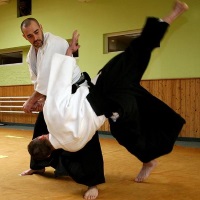
Start Aikido
Training is suitable for men and women of all ages and fitness levels. Join our beginner classes and a senior member will guide you through every step.
Training
Aikido classes are split by level and class type (up to 17 hours weekly). Sessions run in the morning, at noon and in the evening.